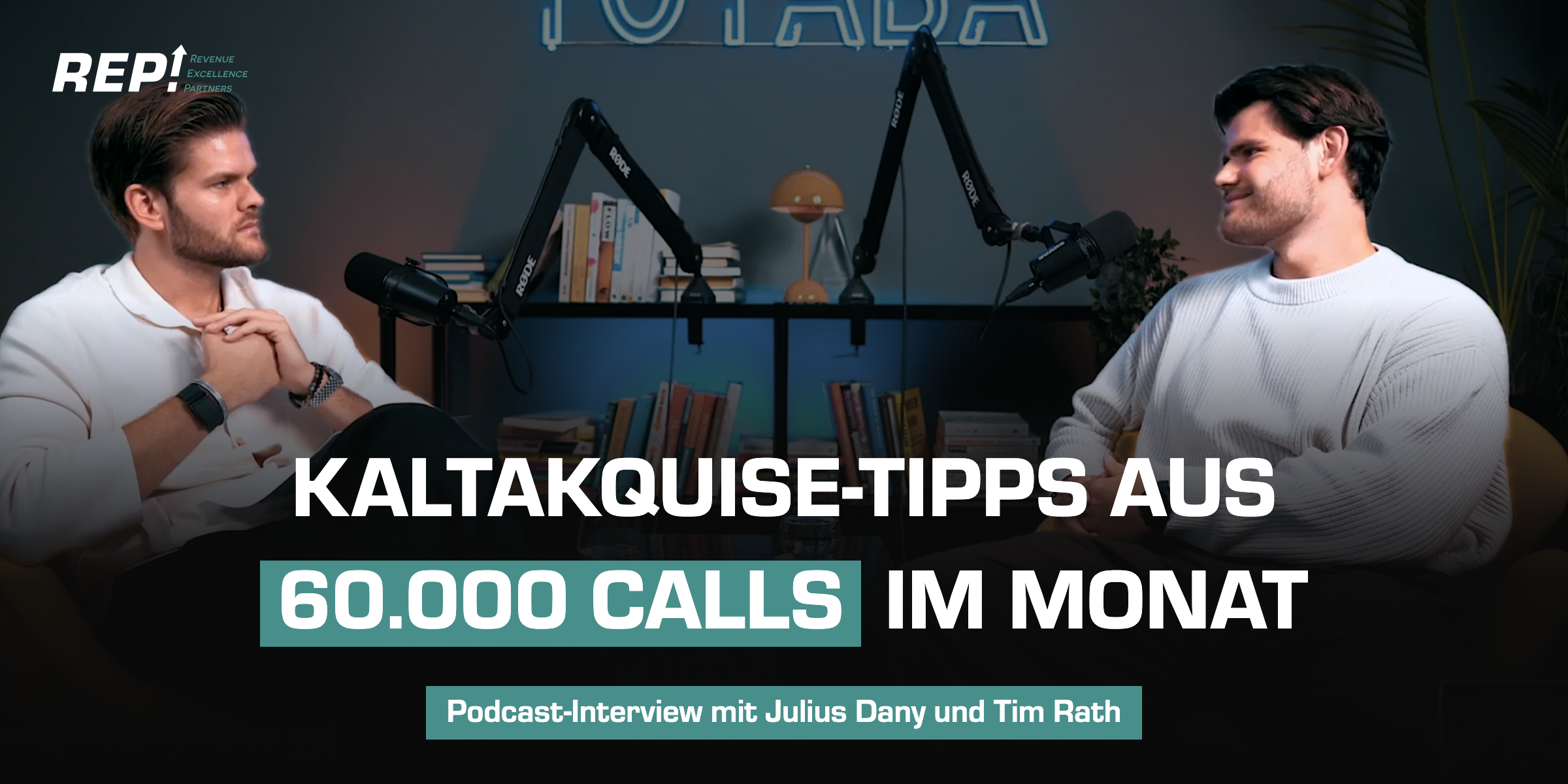
Every month, REP’s team makes 60,000 to 80,000 calls for B2B companies in technology and IT services. Those conversations show which decision-makers are reachable and where most cold calls lose the opportunity to book a meeting. In the podcast Revenue Marketing Realtalk, YOYABA’s Tim Rath spoke with Julius Dany about exactly these lessons. This article brings together the interview’s practical tips and adds current research and examples for your own phone-based sales process.
Key takeaways
- REP makes 60,000 to 80,000 cold calls every month. Depending on the industry, call-to-connect rates reach up to 30%.
- The persona determines reachability. A fleet manager almost always has a phone nearby; a CFO may spend the entire day in meetings.
- According to a Cognism analysis, the best windows for reaching decision-makers are 10–11 a.m. and 2–3 p.m.
- Cold calling becomes economical at a contract value of roughly €15,000. From that level, one deal can cover the many calls and meetings required to win it.
- REP projects generate an average of eight to twelve sales-qualified leads per month.
Contents
- Julius Dany’s path into cold calling
- The persona determines how easily you reach decision-makers
- The right calling time improves reachability
- Which companies benefit from cold calling?
- Preparing for the target group is enough
- A cold-call pitch follows four steps
- Eight to twelve qualified meetings per month are realistic
- AI supports preparation; a person leads the conversation
- A cold-calling team needs only four core tools
- Frequently asked questions about cold calling
Julius Dany’s path into cold calling
Julius Dany leads REP as CEO and co-founder. He studied business administration in Münster and at Vancouver Island University. At SYNTINELS, an AI start-up for sales triggers, he progressed from intern to Head of Go-to-Market and learned how data-led sales works in practice. Today, he is responsible for sales and customer projects at REP together with fellow founders Julius Göllner and Robert Borchert. The team has supported almost 100 outbound projects in B2B technology and IT services.
The persona determines how easily you reach decision-makers
Who you call determines your connect rate. A Cognism analysis of more than 200,000 calls found an average cold-call success rate of 2.7%. Behind that average are major differences between target groups.
The day-to-day reality of the person being called makes the difference. A fleet manager keeps a phone close because drivers may need immediate support after an accident. A CFO, by contrast, can spend most of the day in meetings and rarely pick up.
Plan cold calling by persona. In one project for an ERP system used in facility management, the managing directors’ mobile numbers were published directly on company websites. REP booked 15 meetings in a single week.
The right calling time improves reachability
The strongest windows during the working week are late morning and early afternoon:
Time windowReachabilitybefore 9 a.m.low10–11 a.m.highest, with the longest conversations12–1 p.m.low2–3 p.m.highafter 4 p.m.low
Thursday performs best, followed by Tuesday. Friday drops off.
Tools such as Call Time help teams plan more precisely. Through Microsoft Teams integration, they indicate whether a contact is in a meeting or currently available. Calling only available contacts increases the number of conversations per hour.
The phone number also affects whether someone answers. REP tests whether each target group responds better to landline or mobile numbers. Results from current projects are fed into every new engagement, so campaigns start with settings that have already worked for comparable audiences. REP runs those tests for the customer.
When a call connects, many decision-makers are first protected by a gatekeeper—usually reception or an executive assistant. Gatekeepers help when they are treated as conversation partners. An executive assistant knows a manager’s calendar and when they can be reached. If the assistant mentions that the executive is currently at a golf retreat, use that context on the next call. “I hope the golf retreat went well—Ms Meier mentioned it” creates a very different opening from a completely cold introduction.
If the assistant’s first response is “not interested,” keep the conversation moving. Two approaches help:
- Ask about timing: “When is the best time to reach Mr Weber? I would like to speak briefly about appointment conversion in field sales.” The assistant decides on the time, while the conversation itself is already positioned as the next step.
- Ask for advice: “Perhaps you can help me. Who is responsible for new-customer acquisition?” Sometimes the assistant connects the call directly. More often, you at least learn the responsible person’s name and can ask for them specifically next time.
State your name and purpose in one sentence. Evasive answers make gatekeepers suspicious.
Which companies benefit from cold calling?
Cold calling makes commercial sense for B2B companies with a contract value of around €15,000 or more. Below €10,000, the business model is often too transactional: too many meetings are needed before one deal becomes economical compared with an inbound lead.
REP reviews four factors before starting a project.
CriterionStrong foundationDifficult foundationContract value€15,000 or morebelow €10,000Market size10,000–15,000 target companies, such as mid-market ERP buyersaround 300 companies, for example in medical technologyProduct-market fitcustomers in the target group already buy the productthe product is still in developmentSales closingaccount executives close outbound meetingsthe team only knows inbound enquiries
A qualified meeting produces revenue only when the product is market-ready and account executives can close. REP therefore helps existing sales teams build cold-calling capability through coaching based on transcripts from live projects. Teams that previously handled inbound enquiries learn to lead outbound conversations and move them toward a close.
Should your team run outbound internally?
In the Sales Assessment, we review your sales process and identify where cold calling can contribute. Book a meeting
Market conditions matter as well. Inbound volume is declining for many companies as buyer research shifts toward AI search. At the same time, mid-market customers are buying less from existing suppliers than they did in previous years. New customers therefore arrive less often on their own. Active outbound sales counterbalances both trends. Our article on sales outsourcing versus an internal SDR team explains the available operating models.
Preparing for the target group is enough
Many sales development representatives spend 15 minutes researching each contact and then fail to reach them. Before the next attempt, they reread notes about the company and individual. This consumes time without creating many meetings. A VP of Sales is persuaded by a solution to a real problem; a shared university or hobby rarely changes the outcome.
A clear pitch describes a common target-group problem in two sentences and then asks how the prospect handles it. For route-planning software, the opening might be: “We are speaking with fleet managers whose dispatchers spend an hour every morning working through Excel sheets. How do you handle that today?” The pitch reflects the target group’s daily work. The product only enters the conversation during discovery.
Every vendor now uses sales signals. After a funding round, founders receive simultaneous messages from recruitment agencies and software providers through LinkedIn and WhatsApp. A signal is useful only when it closely relates to the product.
Typical B2B sales signals include:
- a funding round
- a new sales or marketing leader
- open sales roles
- expansion into a new country or location
- a CRM migration
REP uses signals in projects where they directly fit the offer.
Preparation covers four areas. It is completed once before the campaign and then applies to every call.
AreaWhat it includesHow it helps in the callIdeal customer profileindustry, company size, region and personayou call companies that fit the offerValue propositionthe target group’s problem and your solution in two sentencesopening and pitchCase studiesresults from comparable customersanswers to objections and follow-up questionsFollow-up materialswhite paper or one-pagerfollow-up email immediately after the call
A cold-call pitch follows four steps
A strong cold call starts with an open question, moves into structured discovery, checks qualification criteria and ends with a concrete meeting proposal.
- Open with a question: Start with an open question. A closed question quickly produces the first “no” and can end the conversation. A better opening is: “We speak with many VPs of Sales who face the following problem. How do you handle it?”
- Run discovery: Once the prospect talks about their process, ask two to five follow-up questions. Understand the situation before explaining your offer.
- Qualify: Compare the answers with your company’s criteria. REP uses the SPICED model.
- Move to a meeting: Offer two specific times, such as Tuesday or Thursday after 2 p.m. Many SDRs forget this step. Only a clear invitation turns good discovery into a meeting.
In the podcast, Julius describes the mistake like this: “They have already been talking to the customer for ten minutes instead of saying: You know what, let’s simply schedule a meeting at this point.” Our cold-calling framework explains the conversation structure in more detail.
The pitch also depends on the person making the call. Loud, extroverted SDRs were long considered the ideal profile. REP’s experience shows something different. One introverted SDR now works exclusively on cybersecurity projects. His calm, precise style fits the CISOs and CTOs who make buying decisions in that market. The fit between caller and buyer shapes the quality of every sales conversation.
Eight to twelve qualified meetings per month are realistic
REP generates an average of eight to twelve sales-qualified leads per project each month. In projects with very high reachability, the number is significantly higher.
A meeting counts as an SQL only after the customer confirms it. This protects both sides from meetings that look good only on paper. REP qualifies with SPICED: Situation, Pain, Impact, Critical Event and Decision. During the cold call, the SDR establishes how the company currently works and what the problem costs. The customer’s account executive explores the critical event and final decision-maker in the first meeting. Once the customer confirms the information and the company fits the ICP, the SQL is counted.
The sipgate case study shows how a partnership develops over time. REP started there with one person and now provides a complete team.
AI supports preparation; a person leads the conversation
At REP, only people make calls. The main reason is legal. In Germany, traditional B2B cold calls may rely on presumed consent when there is a clear business relevance. Advertising through an automatic calling machine, however, requires prior explicit consent under Section 7(2)(2) of the German Unfair Competition Act, including in B2B. In REP’s assessment, an AI phone agent falls under this stricter rule. The EU AI Act adds transparency requirements: since 2 August 2026, AI systems that interact with people must disclose that they are AI. That opening notice reduces people’s willingness to continue listening.
REP’s customers take the same view. “When I speak with our customers, nobody wants their own customers to be approached by AI,” says Julius Dany. Our German guide to B2B cold-calling law explains the legal framework in more detail.
REP does use AI extensively in strategy and pre-analysis. A full-time AI engineer works on these applications.
The most important uses of AI in sales are:
- SQL validation: AI compares call transcripts with the customer’s SQL criteria. Across 100 meetings per week, it identifies around three that a customer rejected despite the criteria being met. REP stores only the conversation text.
- Lead generation: AI creates target-group contact lists much faster.
- Conversation analysis: AI extracts SPICED criteria from sales calls and transfers them to the CRM.
- Handover to onboarding: Information from the sales conversation automatically reaches the onboarding team, so customers answer the same question only once.
The conversation itself remains human. REP expects little change in the DACH region over the next five years.
A cold-calling team needs only four core tools
REP’s core stack consists of four systems.
ToolRole at REPClaylead generation and consolidation of data sourcesAdversusdialler for 60,000 to 80,000 monthly callsGemininotes from internal and external meetings and evaluation of SPICED criteriaHubSpotCRM that stores conversation data automatically
Keep the tool selection short.
“Most teams spend three months deciding which lead-generation tool to buy. But whether you use Lusha, Apollo, Call Time or Better Contact does not determine whether you book one meeting or ten.”
Julius Dany explains in the conversation.
Target group and pitch ultimately determine the number of meetings.
Conclusion
Cold calling works when reachability shapes audience planning and every relevant conversation ends with a meeting proposal. Two developments will make the phone even more valuable over the next few years.
First, AI tools are filling email and LinkedIn inboxes with generic, automated messages. A call from a person stands out precisely because it is difficult to automate. The more other channels run automatically, the more valuable personal conversation becomes.
Second, every conversation creates knowledge for marketing and product teams. Thousands of monthly calls reveal common objections and the problems buyers care about. Feeding those insights back into marketing sharpens messaging across every channel. Marketing, in turn, improves call performance through measures such as account-based campaigns before the first call. Sales and marketing come together as one revenue team.
Start by checking contract value and market size. If both fit, an initial conversation with REP can estimate how many meetings are realistic for your offer.
Listen to Tim Rath’s full conversation with Julius Dany in episode 132 of Revenue Marketing Realtalk on Spotify.
Frequently asked questions about cold calling
How many cold calls does it take to book a meeting?
That depends on the target group’s call-to-connect rate. At REP, it reaches up to 30% depending on the industry. Highly reachable personas such as fleet managers require far fewer attempts than CFOs.
At what contract value is cold calling worthwhile?
From roughly €15,000. Below that level, too many meetings are needed per deal for the effort to compete with inbound leads. A cold-calling agency such as REP therefore makes the most sense for complex products with higher contract values.
Should teams call cold prospects or only warm contacts?
REP also calls completely cold contacts who are hearing the customer’s company name for the first time. Warmer contacts increase success rates, for example through advertising or out-of-home campaigns before the call. Our German article on warm calls versus cold calls explains the difference.
How important is the brand in cold calling?
Very important. An unknown start-up may need to repeat its name three times, while a call from a recognised brand begins with more trust. Even more important is a clear message about the problem you solve for the target group.
About the author
Julius Dany is co-founder and CEO of REP. Over the past several years, he has built and supported hundreds of outbound processes for mid-market B2B companies. REP helps companies create predictable pipeline, from the first target-group definition to a qualified meeting in the internal sales team’s calendar.